

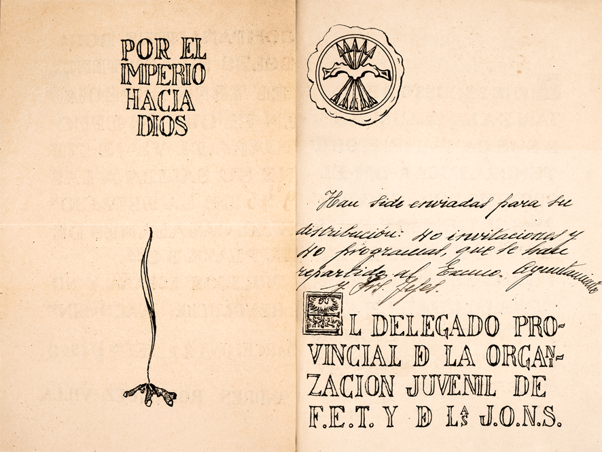
During the Spanish Civil War (1936–39), political parties were dissolved in the territory controlled by the Francoist military forces. Left-wing political organisations, as well as trade-union confederations, disappeared as a result of severe repression, while right-wing political forces were merged through a Unification Decree issued on 19 April 1937, by General Francisco Franco.
Between 1940 and 1960, the political indoctrination and education of children and young people under Francoism was primarily carried out by the Youth Front (Frente de Juventudes), established in 1940 and placed under the authority of the Falange1Falange was the Spanish fascist-inspired political movement founded in 1933 by José Antonio Primo de Rivera. After the outbreak of the Spanish Civil War, it became the regime’s official political organisation and one of the main instruments for promoting Francoist ideology. In Spahis the party is called FE de las JONS (Falange Española de las JONS).. Its role was not limited to political control; it also sought to shape the new generations according to the regime’s ideological, moral and religious principles through indoctrination disguised as education, sporting, leisure time and political training activities.
The Frente de Juventudes was primarily directed at boys, while the education and training of girls and young women was the responsibility of the Women’s Section (Sección Femenina) of the Falange, whose programmes were adapted to the gender roles promoted by the regime. In 1960 the Frente de Juventudes was replaced by the Spanish Youth Organization (Organización Juvenil Española; OJE), which continued to organise activities aimed at youth mobilisation and socialisation, such as summer camps, excursions, sports, civic education and outdoor activities. The OJE maintained a strong emphasis on the nationalist, Catholic and disciplinary values of Francoism and remained active in promoting these values until 1977.2At that time, it severed its ties with the State and was officially recognised in 1978 as an independent, private association focused on non-formal education for young people. Today it remains active under the official name of the Spanish Youth Organisation, a prime example of the process of dememorialisation by the State that characterised the Spanish transition.
The Frente de Juventudes operated through various channels. These included certain subjects within the educational system, such as Formación del Espíritu Nacional (Formation of the National Spirit) and Physical Education.3Ramírez-Macías, G. (2024). ‘Los campamentos de las Falanges Juveniles de Franco (1942–1959). Disciplina, obediencia y ardor al servicio de la Falange y de España’ en Materiales para la Historia del Deporte (28), p. 102. The organisation drew its main inspiration from the powerful youth organisations of contemporary dictatorships, particularly the Hitler Youth (Hitlerjugend) in Nazi Germany and then the Opera Nazionale Balilla in Mussolini’s Italy.4Castillejo Cambra, Emilio. (2021) ‘Manual de Campamentos del Frente de Juventudes (ediciones de 1943 y 1948): variaciones en torno a la cultura politica y la disciplina de los cuerpos en la Espana franquista’ en Historia y Memoria de la Educación 13, p. 503.
The Youth Front did not seek to become a mass organisation and recruit as many members as possible.
Active members came from families sympathetic to the regime, but also from poor families who saw the organisation as a way for their children to have clothes, a proper light meal in the afternoon (merienda) and go on outings. Nevertheless, it is important to note that the entire community of young people was influenced by this effect and indoctrination discourse.
- 1Falange was the Spanish fascist-inspired political movement founded in 1933 by José Antonio Primo de Rivera. After the outbreak of the Spanish Civil War, it became the regime’s official political organisation and one of the main instruments for promoting Francoist ideology. In Spahis the party is called FE de las JONS (Falange Española de las JONS). ↩︎
- 2At that time, it severed its ties with the State and was officially recognised in 1978 as an independent, private association focused on non-formal education for young people. Today it remains active under the official name of the Spanish Youth Organisation, a prime example of the process of dememorialisation by the State that characterised the Spanish transition. ↩︎
- 3Ramírez-Macías, G. (2024). ‘Los campamentos de las Falanges Juveniles de Franco (1942–1959). Disciplina, obediencia y ardor al servicio de la Falange y de España’ en Materiales para la Historia del Deporte (28), p. 102. ↩︎
- 4Castillejo Cambra, Emilio. (2021) ‘Manual de Campamentos del Frente de Juventudes (ediciones de 1943 y 1948): variaciones en torno a la cultura politica y la disciplina de los cuerpos en la Espana franquista’ en Historia y Memoria de la Educación 13, p. 503. ↩︎