

Social Assistance (Auxilio Social)
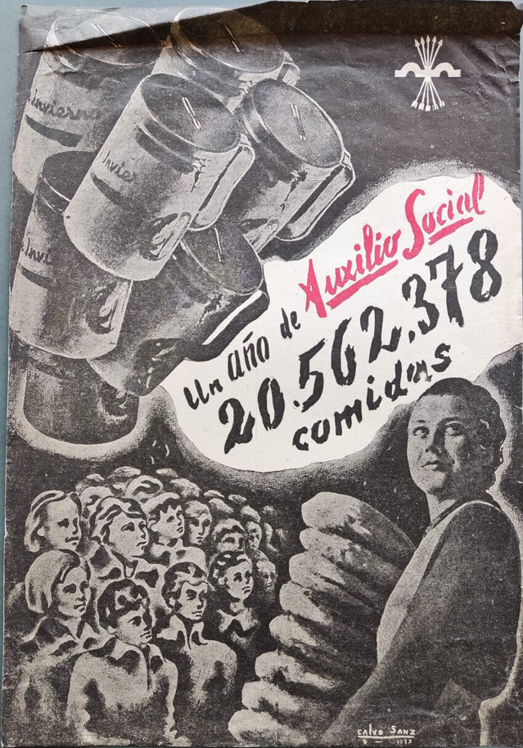
Social Assistance (Auxilio Social) was one of the main institutions of the early Franco regime and played a fundamental role in shaping the dictatorship’s social assistance policies. Despite the fact that it tried to reduce hunger and poverty, its charitable activities were profoundly instrumentalised to achieve political objectives and strengthen the regime’s social and ideological control.
It emerged in October 1936, during the Civil War and in the Francoist zone, under the name Winter Relief (Auxilio de Invierno), inspired by its Nazi ally, with the initial aim of providing assistance to the population affected by the war. It was subsequently incorporated into the regime’s official structures.
With regard to children, Social Assistance provided support to orphans, children from poor families and children whose parents were in prison. Infant mortality in Spain at the time was extremely high, mainly due to hunger and the lack of medicines resulting from the autarkic policies* of the regime, with between 10 and 22 per cent of children under the age of five dying.1Infant Mortality in Spain, 1903–1950. 1951 Yearbook – Documentary Collection of the National Statistics Institute.
*Autarky in Francoist Spain was a policy of economic self-sufficiency, state control and restricted foreign trade, pursued mainly from 1939 to 1959, which contributed to shortages, stagnation and declining living standards.
Through welfare provision, the regime sought to shape a generation of children adapted to the values of the new Francoist society.2Román Ruiz, G. (2024). Mothers and children without bread. Hunger in the Auxilio Social Cocinas de Hermandad and Comedores Infantiles during post-war Francoism (1939–1940). Culture & History Digital Journal, 13(2), p. 521. Recent research has also shown that the material conditions in some of the canteens were extremely poor, that the rations provided were insufficient and that many of the workers stole food and supplies. Thus, the two main objectives of Social Assistance – to reduce hunger and to convince the population of the new regime’s generosity and good intentions –ultimately failed.3Ibid.
Catholicism in the Youth Front (Frente de Juventudes)
Spain is a country with a strong Catholic tradition, where the Catholic Church played an important role. Since the early 2oth century secular and anti-clerical movements were already growing, especially among workers, socialists and anarchists. The Catholic Church, and, in particular, the power it held became one of the main causes of political division.
Catholicism occupied a central role in the ideological and moral education promoted by youth organisations associated with Francoism. Both the Youth Front, established in 1940, and later its successor, the Spanish Youth Organisation (OJE), founded in 1960, incorporated Catholic doctrine as one of the principal means of socialising children and young people.
Religious education was integrated into young people’s daily lives: attending Mass, prayers, religious celebrations and the teaching of content related to Catholic doctrine formed part of the organised activities. At the camps, for example, it was common for certain days to begin or end with religious activities, as well as for participants to take part in Catholic ceremonies and celebrations. In Spain religion was not confined to the private sphere; rather, it contributed to shaping models of behaviour and ways of understanding society.
Spaniards did not recognise the existence of any faith other than Catholicism, and atheism was associated with political practices that were heavily repressed. In society the priest wielded considerable power; not attending Mass meant putting yourself in the sights of a repressive authority and marking yourself out politically.
At Youth Front camps, there was always a chaplain, accompanied by one or more assistants. In addition to celebrating Mass and providing religious instruction, they also acted as guardians of morality. The observance of moral standards was considered so important that the chaplain and his assistants monitored the tents and, in particular, the conversations that took place among young people.4Hernández Luis, José Luis (2021). ‘Mitad monje, mitad soldado. Los campamentos del Frente de Juventudes en San Pedro de las Herrerías (Zamora) como elemento paraeducativo durante la Posguerra’. Studia Zamorensia, p. 55.
Children’s Literature
Reading and books during the Franco period were profoundly shaped by the new political regime. Books associated with political movements opposed to Francoism –namely socialist, communist, anarchist, Republican and feminist currents, as well as those associated with workers’ organisations – were systematically destroyed. The same fate befell works by authors whom the Franco regime censored in Spain, regardless of the content of their works. International authors who were subjected to censorship included Voltaire, Émile Zola, Victor Hugo, Jules Verne, Sigmund Freud and Mary Wollstonecraft, as well as Thomas Mann, among a very long list of others.
This proclamation, published on 1 August 1936 in the Falangist newspaper ¡Arriba España! Hoja de combate de la FE de las JONS (Long live Spain! Combat Bulletin of FE de las Jons) illustrates this perfectly:
Comrade! You have a duty to fight Judaism, Freemasonry, Marxism and separatism.5‘Separatism’ was the term used – and is still used today – by the Spanish right to refer to peripheral nationalist movements, particularly significant in Catalonia, Galicia and the Basque Country. With regard to books, publications in these three languages were censored and suppressed, although they survived clandestinely during the dictatorship, mainly through private and family use. Destroy and burn their newspapers, books, magazines and propaganda. Comrade! For God and the Fatherland!6Ana Martínez Rus, ‘No sólo hubo censura: la destrucción y depuración de libros en España (1936–1948)’, Creneida, n.º 5 (2017), p. 39.
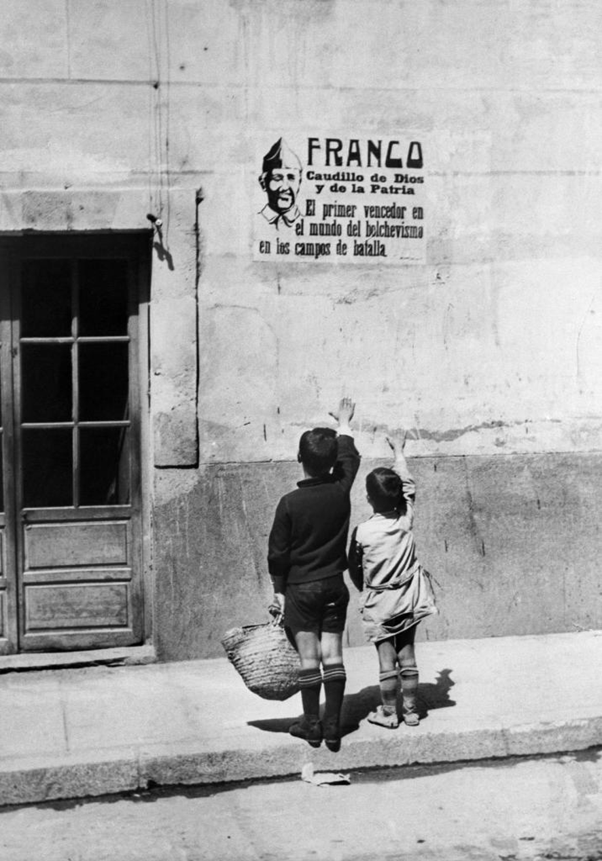
Reading policy was also closely linked to education and to the influence of the Catholic Church and the Falange on children. In fact, simple reading books were promoted as the dominant ‘educational’ genre in post-war schools.7This statement is taken from Escolano Agustín (1998), Historia ilustrada del libro escolar en España. De la posguerra a la reforma educativa, Madrid, Fundación Germán Sánchez, p. 23, cited in Mahamud Angulo, K. (2007), ‘El libro de lectura como manual de instrucciones para el sentimiento infantil durante el primer franquismo’, Universidad Nacional de Educación a Distancia (UNED), n.p. It is particularly important to consider the ways in which Francoist education placed a strong emphasis on influencing children’s emotional development.8The ways in which Francoism sought to shape and construct the emotional lives of post-war children have been studied by Professor Kira Mahamud Angulo.
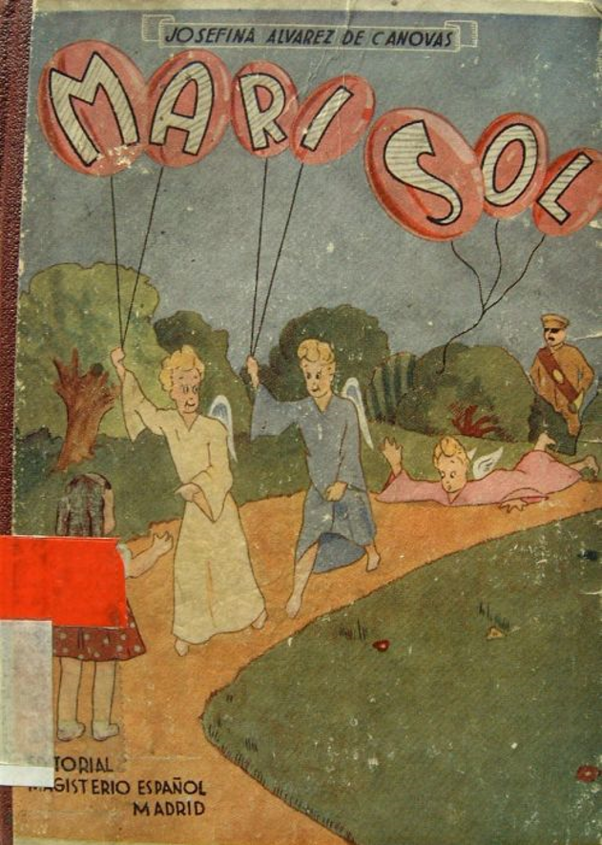
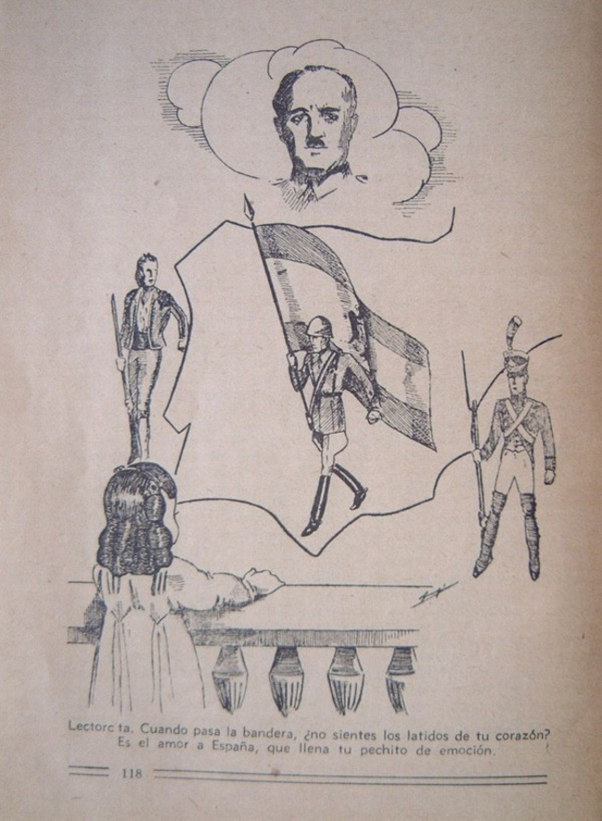
The document that we show here is a page from one of these Francoist reading books, entitled Mari-Sol. It depicts a girl, Mari-Sol, looking out from a balcony after watching a parade. Before her is the silhouette of Spain, with soldiers marching across it, one of them carrying the flag. At the top of the drawing is the deified figure of Franco. The text added by the author provides the key to the lesson:
‘Little reader, when the flag goes by, don’t you feel your heart beating? It is love for Spain, filling your little chest with emotion.’9Mahamud Angulo, K. (2007). ‘El libro de lectura como manual de instrucciones para el sentimiento infantil durante el primer franquismo’. Universidad Nacional de Educación a Distancia (UNED), s.p.
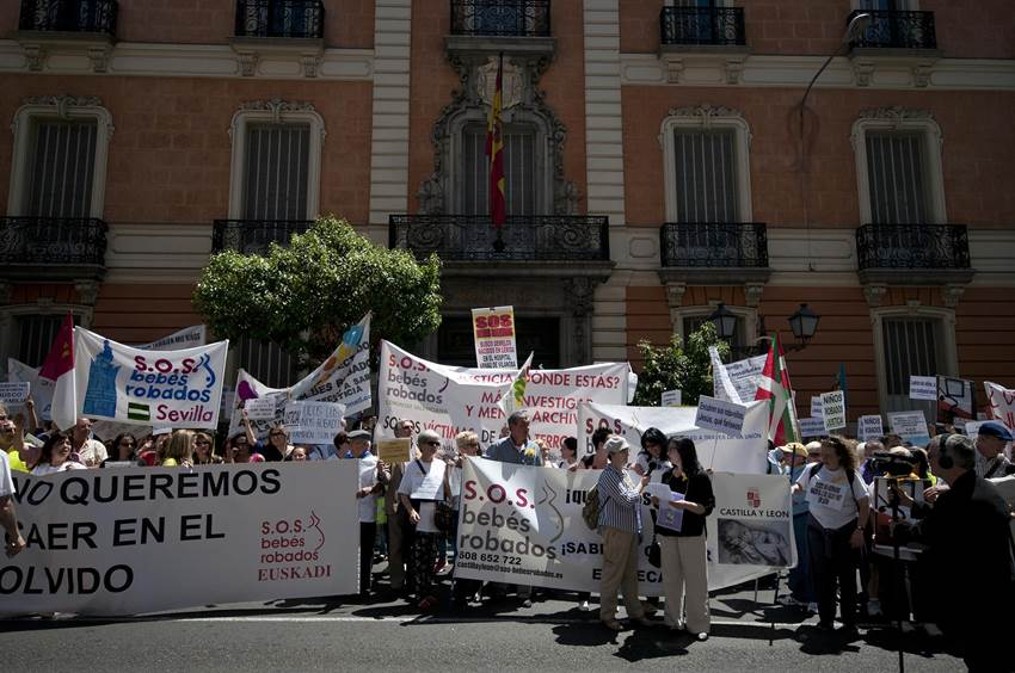
Missing Children, Stolen Children
The abduction of children in Spain took place between 1939 and the early 1990s, although the reasons used to justify these practices changed over the course of this period.
Between 1939 and 1952, the abduction of children was primarily justified by the theory of the ‘red gene’, developed by psychiatrist Antonio Vallejo-Nájera. This theory claimed that there was a supposed genetic and psychological abnormality associated with people considered to be Marxists. According to the order issued by Judge Baltasar Garzón on 18 November 2008, between 1939 and 1952 approximately 30,960 minors10Calvo Alonso, B. (2024). ‘El gen rojo como germen de la trama de robos de bebés durante el Franquismo’. Revista de Antropología Experimental, (24), p. 322. may have been taken from prisons and maternity hospitals under the guise of so-called ‘positive eugenics’, which justified separating children from their left-wing mothers, who were considered sick or ideologically dangerous. This context also included the case of orphaned children repatriated from exile and forced to return to Spain.
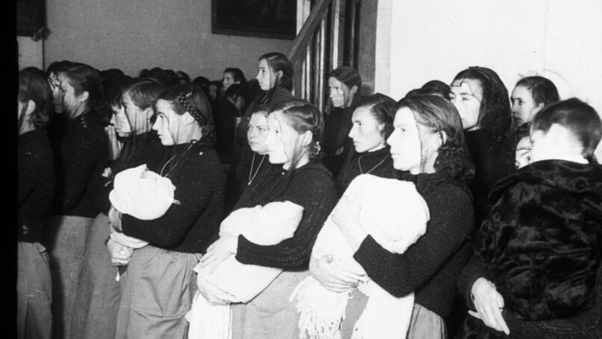
During the 1950s and until the end of the Franco dictatorship, the theory of the red gene gradually lost importance, but the practices of child abduction continued to affect other groups. These included the so-called ‘children of poverty’ and ‘children of shame’, particularly those born to unmarried mothers, or to women who did not conform to the models of female behaviour imposed by the regime, whether because of their conduct, their political activity or their poverty, sometimes coming from large and highly vulnerable families. Sexual workers were, of course, a particular target. Abductions took place in clinics and maternity hospitals, many of which were linked to or influenced by religious institutions. In most cases, mothers were sedated and subsequently told that their baby had died, but in reality the child had been handed over to another family.
During the 1980s and 1990s, some of those affected beganto file complaints and legal claims, although still very sporadically, in an attempt to establish what had happened. Subsequently, the rise of Spain’s historical memory movement contributed to greater visibility for these cases and encouraged a process of collective awareness regarding the existence and consequences of these practices.
Prison and Childhood
In Francoist Spain, numerous women serving prison sentences gave birth in prison, where they were allowed to remain with their children until they reached the age of three. Some of these women were already pregnant when they were arrested, while others conceived children as a result of abuse suffered in detention.11Sexual and gender-based repression against women during the dictatorship has been documented in numerous studies. To explore this subject further, we recommend reading the article by Ranz Alonso, E. (2019). ‘La represión franquista contra la mujer’. Femeris. Revista Multidisciplinar de Estudios de Género, 4(3), pp. 53–70, and/or the book edited by Conxita Mir and Ángela Cenarro (2021). Mujeres, género y violencia en la guerra civil y la dictadura de Franco, Valencia, Tirant Humanidades.
When the children reached the age of three and had to leave prison, they were rarely returned to their biological families if these were considered hostile to the regime. Two key legal mechanisms facilitated this. On the one hand, the State was automatically granted parental authority over children whose families had what the regime described as a ‘bad political or moral record’; this authority was, in turn, delegated to Social Assistance (Auxilio Social). On the other hand, reception centres were authorised to change the names and surnames of minors. By altering their civil identity, their genealogy was erased, making it impossible for their mothers or close relatives to locate them or reclaim them after their release from prison.
The Militarisation of Childhood
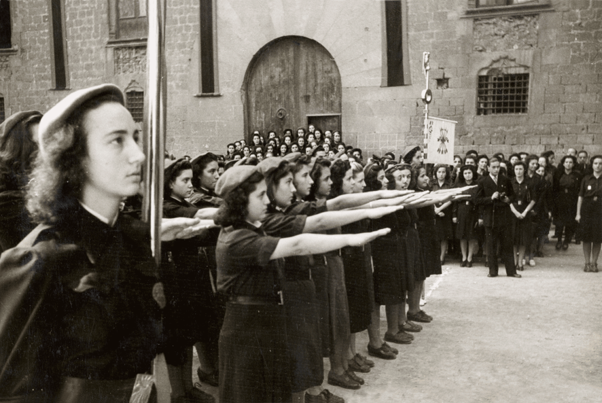
Occupying public space was an important objective of Francoism. Under the model of National Catholicism, the boundaries between Church, school and street became blurred. Public space was shaped by sacralisation and militarisation, which had a particularly strong impact on children. The Youth Front organised parades in which children emulated military processions. The following extract from a children’s reading book, from a chapter entitled ‘A Parade in the Village’, serves as an example:
Almost all the children in the village where we spent our holidays belonged to Falange’s youth organisations […]. Our father wanted us to join them so that we could march before the authorities. Dressed in immaculate uniforms, we marched through the streets of the village, commemorating the anniversary of our liberation. Afterwards, we laid a wreath at the Cross of the Fallen and sang Cara al Sol.12Torres, Federico (1945). Mis amiguitas, Madrid: Librería y Casa Editorial Hernando, p. 62. Aparece citado en el artículo Mahamud Angulo, K. (2007). ‘El libro de lectura como manual de instrucciones para el sentimiento infantil durante el primer franquismo’, Universidad Nacional de Educación a Distancia (UNED), s.p.
This book was written as a children’s reading book, with girls in particular in mind. The day of the parade referred to was 1 April, ‘Victory Day’, which commemorated the end of the war and Francoist victory. Every 1 April between 1939 and 1975, military parades were held throughout the country. The song mentioned in the extract was also a martial song, the anthem of the Falange and one of the most recognisable symbols of allegiance to the dictatorship.
The Uniform
The uniform of the Youth Front was much more than clothing intended to identify its members. It formed part of a strategy of political socialisation aimed at instilling the values of the dictatorship in children and young people.
The uniform consisted of a dark blue shirt (used as the general uniform of the single party, the Falange) and a red beret (a symbol of the traditionalist political movement, Carlism). The boys also wore a belt with a buckle bearing the Yoke and Arrows. The footwear commonly worn was white espadrilles, a type of shoe associated with the working classes, and with the traditional dress of many regions of Spain.
The girls’ uniform also included the shirt and beret but a skirt replaced the trousers.
For a Spain impoverished and weakened by hunger, seeing this uniform represented a symbolic boundary: ‘opposite them stood a healthy and clean Spain’,13Rodríguez Barreira, Óscar J. (2011). ‘Auxilio Social y las actitudes cotidianas en los Años del Hambre, 1937-1943’. Historia del presente, 17, pp. 127–47. as well as one that was well dressed. It conveyed an idealised image of the new Spain: the neat and disciplined appearance projected by the youth organisations contrasted sharply with the everyday reality. For a population marked by defeat, poverty and the consequences of the war, the reality in this post-war period was characterised by shortages and strategies for survival.
Many sons and daughters of people affected by the harshness of the dictatorship engaged in what Rodríguez Barreira describes as ‘instrumental submission’ towards the Youth Front or Social Assistance (Auxilio Social). Rodríguez Barreira expresses it as follows:
Despite the working-class background of their families and neighbours, most of the children were strongly attracted to the Falange’s image and immaculate uniforms. The role played by image was very important in the fascination caused by FET-JONS (Editor’s note: Falanga, The only political party legally permitted in Spain during General Francisco Franco’s dictatorship) but even more important were people’s desperate material circumstances and the way the organisation took advantage of them.14Ibid.
The Yoke and Arrows Emblem
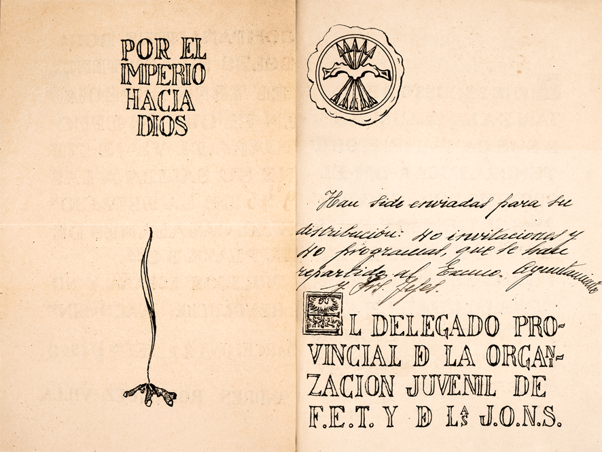
The Yoke and Arrows is one of the most recognisable political symbols of Francoist Spain. Although during the dictatorship it became closely associated with the single-party Falange and the regime’s political apparatus, its origins predate the Franco regime.
The symbol of the Yoke and Arrows, consisting of a bundle of arrows bound together with a yoke placed above them, derived from the emblems of the Catholic kings (1474–1504), whose reigns saw the consolidation of the conquest of the Americas. The Falange, a Spanish political party with a fascist ideology founded by José Antonio Primo de Rivera in 1933, revived this historical symbol and gave it a new political meaning, associating it with the unity of Spain, ‘strength‘, ‘discipline‘ and ‘national greatness‘.
During the Franco dictatorship, it became part of the regime’s official symbolism. It appeared on flags, uniforms, documents, buildings and insignia, becoming an instantly recognisable image of the new state. Its use allowed Francoism to present itself as the heir to a Spanish historical tradition.
Its presence within the Youth Front (Frente de Juventudes) had particular significance. This organisation sought to educate young people in the political and social values of the regime and to instil in them a strong sense of collective belonging. For this reason, the Yoke and Arrows was incorporated into the Youth Front’s logo.
In this image, a detail from a Youth Front document issued in 1941, the Yoke and Arrows appear alongside the phrase ‘through the Empire to God‘, a clear declaration of the intentions of Francoist ideology.
The Patronato de Protección a la Mujer (Women’s Protection Board)
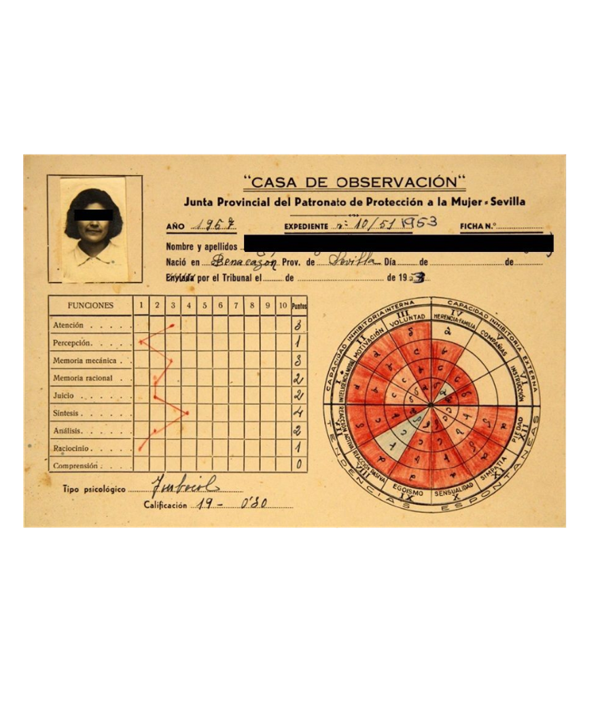
The Patronato de Protección a la Mujer (Women’s Protection Board) was an institution established in 1941 with the stated aim of protecting women aged 15 and over who were considered to be at moral or social risk.
The document presented here is a psychological classification record produced at one of the Patronato’s Houses of Observation and Classification (Casa de Observación y Clasificación), specifically in 1953.15Virtual Spanish Civil War. Ficha del Patronato de Protección a la Mujer. https://www.vscw.ca/es/node/906 (accessed 22 September 2026).
Minors were particularly vulnerable within this system of control and repression, as many were confined in centres run by the Patronato for reasons such as romantic relationships disapproved of by their families, pregnancies outside marriage, homosexuality or political involvement.
Nevertheless, the initial victims of the institution were women engaged in sex work. The Patronato was run by several religious orders which, during the women’s confinement – which could last for years – used them as forced labour in garment-making workshops.16Momoitio, A. (11 May 2022). Consuelo García Cid: ‘Los centros del Patronato eran lugares de castigo y de mano de obra gratuita’ , Pikara Magazine.
The Patronato was the longest-lasting Francoist institution, remaining active until 1985.
Youth Camps
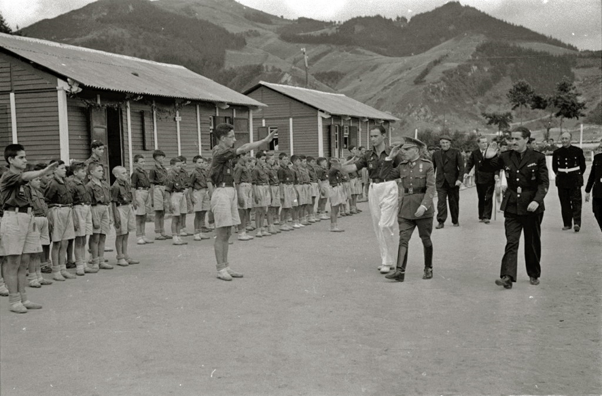
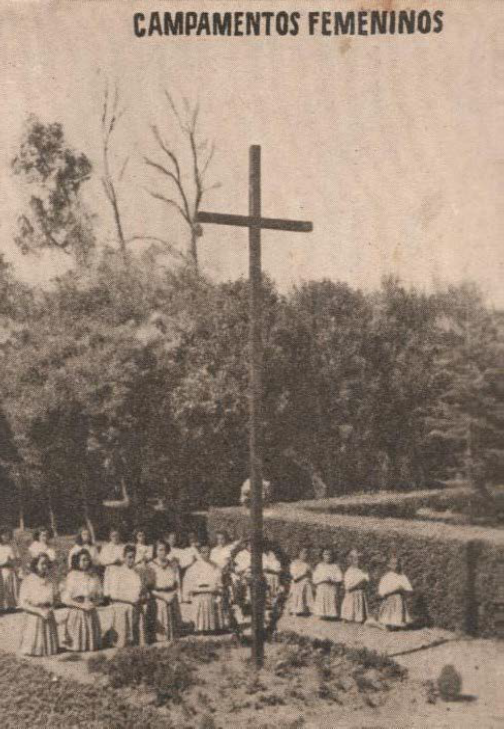
During the summer months, youth camps were organised in different parts of Spain by the Youth Front (Frente de Juventudes), where young people were subjected to a strict timetable for their time and activities. For boys, these camps were held in tents, while for girls they took place in hostels. This distinction can be explained by the fact that the girls’ camps did not have the military character of the boys’ camps but instead were intended to resemble a Falangist “country home”.
At the boys’ camps, participants took part in physical exercises, marches, excursions, sport and group games, as well as political and religious activities. For example, it was common to practise military formations and parades, raise the flag while singing anthems, attend Mass and take part in talks relating to political education. The emphasis on physical education and sporting activities was obsessive, and through these activities ideals of blind obedience, heroism and rigid discipline were instilled.17Ramírez-Macías, G. (2024). Los campamentos de las Falanges Juveniles de Franco (1942–1959). Disciplina, obediencia y ardor al servicio de la Falange y de España. Materiales para la Historia del Deporte 28, p. 102.
Activities at the girls’ camps included paying tribute to those who ‘had fallen’ on the side of the rebels during the war, tending a garden, cleaning and maintaining the house, learning how to set a table, care for crockery and iron, as well as making and mending clothes.18Martínez Cuesta, F. J. (2018). Op.cit. p. 64.
Emilio Castillejo has analysed the manuals edited and published by the regime concerning the organisation of camps between 1943 and 1948. He argues that ‘the camp prefigures the Francoist state in two ways: first, because it has sanitary, logistical and administrative infrastructures […] secondly, because the camp functions as an organic microcosm, a body: the objective of governmental practice is to maintain the unity and vitality of that body’.19Castillejo Cambra, Emilio. (2021) ‘Manual de Campamentos del Frente de Juventudes (ediciones de 1943 y 1948): variaciones en torno a la cultura politica y la disciplina de los cuerpos en la Espana franquista’. Historia y Memoria de la Educación 13, p. 507. Thus, the Camp Manual published by the organisation itself in 1943 stated: ‘[The camps] are nothing more than a foretaste of what we want the people, the city and the future nation to become’.20Delegación Nacional del Frente de Juventudes. (1943). Manual de campamento. Ediciones Frente de Juventudes, p. 12.
Footnotes:
- 1Infant Mortality in Spain, 1903–1950. 1951 Yearbook – Documentary Collection of the National Statistics Institute. ↩︎
- 2Román Ruiz, G. (2024). Mothers and children without bread. Hunger in the Auxilio Social Cocinas de Hermandad and Comedores Infantiles during post-war Francoism (1939–1940). Culture & History Digital Journal, 13(2), p. 521. ↩︎
- 3Ibid. ↩︎
- 4Hernández Luis, José Luis (2021). ‘Mitad monje, mitad soldado. Los campamentos del Frente de Juventudes en San Pedro de las Herrerías (Zamora) como elemento paraeducativo durante la Posguerra’. Studia Zamorensia, p. 55. ↩︎
- 5‘Separatism’ was the term used – and is still used today – by the Spanish right to refer to peripheral nationalist movements, particularly significant in Catalonia, Galicia and the Basque Country. With regard to books, publications in these three languages were censored and suppressed, although they survived clandestinely during the dictatorship, mainly through private and family use. ↩︎
- 6Ana Martínez Rus, ‘No sólo hubo censura: la destrucción y depuración de libros en España (1936–1948)’, Creneida, n.º 5 (2017), p. 39. ↩︎
- 7This statement is taken from Escolano Agustín (1998), Historia ilustrada del libro escolar en España. De la posguerra a la reforma educativa, Madrid, Fundación Germán Sánchez, p. 23, cited in Mahamud Angulo, K. (2007), ‘El libro de lectura como manual de instrucciones para el sentimiento infantil durante el primer franquismo’, Universidad Nacional de Educación a Distancia (UNED), n.p. ↩︎
- 8The ways in which Francoism sought to shape and construct the emotional lives of post-war children have been studied by Professor Kira Mahamud Angulo. ↩︎
- 9Mahamud Angulo, K. (2007). ‘El libro de lectura como manual de instrucciones para el sentimiento infantil durante el primer franquismo’. Universidad Nacional de Educación a Distancia (UNED), s.p. ↩︎
- 10Calvo Alonso, B. (2024). ‘El gen rojo como germen de la trama de robos de bebés durante el Franquismo’. Revista de Antropología Experimental, (24), p. 322. ↩︎
- 11Sexual and gender-based repression against women during the dictatorship has been documented in numerous studies. To explore this subject further, we recommend reading the article by Ranz Alonso, E. (2019). ‘La represión franquista contra la mujer’. Femeris. Revista Multidisciplinar de Estudios de Género, 4(3), pp. 53–70, and/or the book edited by Conxita Mir and Ángela Cenarro (2021). Mujeres, género y violencia en la guerra civil y la dictadura de Franco, Valencia, Tirant Humanidades. ↩︎
- 12Torres, Federico (1945). Mis amiguitas, Madrid: Librería y Casa Editorial Hernando, p. 62. Aparece citado en el artículo Mahamud Angulo, K. (2007). ‘El libro de lectura como manual de instrucciones para el sentimiento infantil durante el primer franquismo’, Universidad Nacional de Educación a Distancia (UNED), s.p. ↩︎
- 13Rodríguez Barreira, Óscar J. (2011). ‘Auxilio Social y las actitudes cotidianas en los Años del Hambre, 1937-1943’. Historia del presente, 17, pp. 127–47. ↩︎
- 14Ibid. ↩︎
- 15Virtual Spanish Civil War. Ficha del Patronato de Protección a la Mujer. https://www.vscw.ca/es/node/906 (accessed 22 September 2026). ↩︎
- 16Momoitio, A. (11 May 2022). Consuelo García Cid: ‘Los centros del Patronato eran lugares de castigo y de mano de obra gratuita’ , Pikara Magazine. ↩︎
- 17Ramírez-Macías, G. (2024). Los campamentos de las Falanges Juveniles de Franco (1942–1959). Disciplina, obediencia y ardor al servicio de la Falange y de España. Materiales para la Historia del Deporte 28, p. 102. ↩︎
- 18Martínez Cuesta, F. J. (2018). Op.cit. p. 64. ↩︎
- 19Castillejo Cambra, Emilio. (2021) ‘Manual de Campamentos del Frente de Juventudes (ediciones de 1943 y 1948): variaciones en torno a la cultura politica y la disciplina de los cuerpos en la Espana franquista’. Historia y Memoria de la Educación 13, p. 507. ↩︎
- 20Delegación Nacional del Frente de Juventudes. (1943). Manual de campamento. Ediciones Frente de Juventudes, p. 12. ↩︎