

This youth learns nothing other than to think German, to act German […] And they will never be free again for the rest of their lives and they will be happy with that.1Diese Jugend lernt ja nichts anderes als deutsch denken, deutsch handeln […] Und sie werden nicht mehr frei ihr ganzes Leben und sie sind glücklich dabei.
Adolf Hitler, speech at Reichenberg (Sudetenland), 2 December 1938.
Key questions
- Was there a realistic alternative to escaping total state control over young people’s lives?
- What tools, beyond the youth organisations themselves, did the regime use to monitor and steer young people’s behaviour?
- In what way did this system of ‘total education’ turn young people into instruments of the regime, and how easy would it have been to notice or resist that at the time?
Introduction
With the seizure of power in January 1933, Hitler’s regime moved quickly to eliminate every organisation that competed for young people’s loyalty. Left-wing youth groups were banned outright, independent youth associations were dissolved or absorbed within a few years and Protestant groups were steadily squeezed out. By the end of 1933, the Hitler Youth was already the only legal youth organisation left besides Catholic youth groups, which held out longest before finally being banned.
A 1936 law formally declared the HJ the sole organisation for ‘the whole of German youth’, but it did not yet make refusal to join a criminal offence. This change came only in 1939, when a new law made membership in the Hitler Youth compulsory for all German children between the ages of 10 and 18. Children were required by law to join, and families could be punished if they did not comply.
The indoctrination of young people aimed to build a new society, one that would accept and support Nazi policy. Members of the Hitler Youth actively took part in various actions, among them the so-called Night of Broken Glass (Kristallnacht) on 9–10 November 1938, in which at least 91 people were killed.
The Hitler Youth’s role changed again once the war began. From 1943 boys were conscripted as anti-aircraft auxiliaries while still formally HJ members, and the Waffen-SS raised a division built almost entirely of 17-year-old HJ members, which fought – and suffered heavy losses – in Normandy. As Germany’s position collapsed, ever younger boys were pulled in: from late 1944 teenagers were conscripted into the Volkssturm,* and Hitler Youth members were among the last defenders of Berlin. The organisation ceased to exist with Germany’s surrender and was formally banned that same year.
* Volkssturm was a militia created by Nazi Germany in 1944, consisting mainly of boys, older men and others not already serving in the armed forces, to help defend the country during the final stages of the Second World War.
Exercise 1 – The law that made Hitler Youth membership compulsory
On 1 December 1936, a new law concerning the Hitler Youth was issued.
Read it below, then answer these questions:
- What would this law have meant, practically and legally, for an ordinary student your age?
- Only starting in 1939 were children required by law to join, and families could be punished if they did not comply. How do you imagine the period between this document (1936) and 1939 was like?
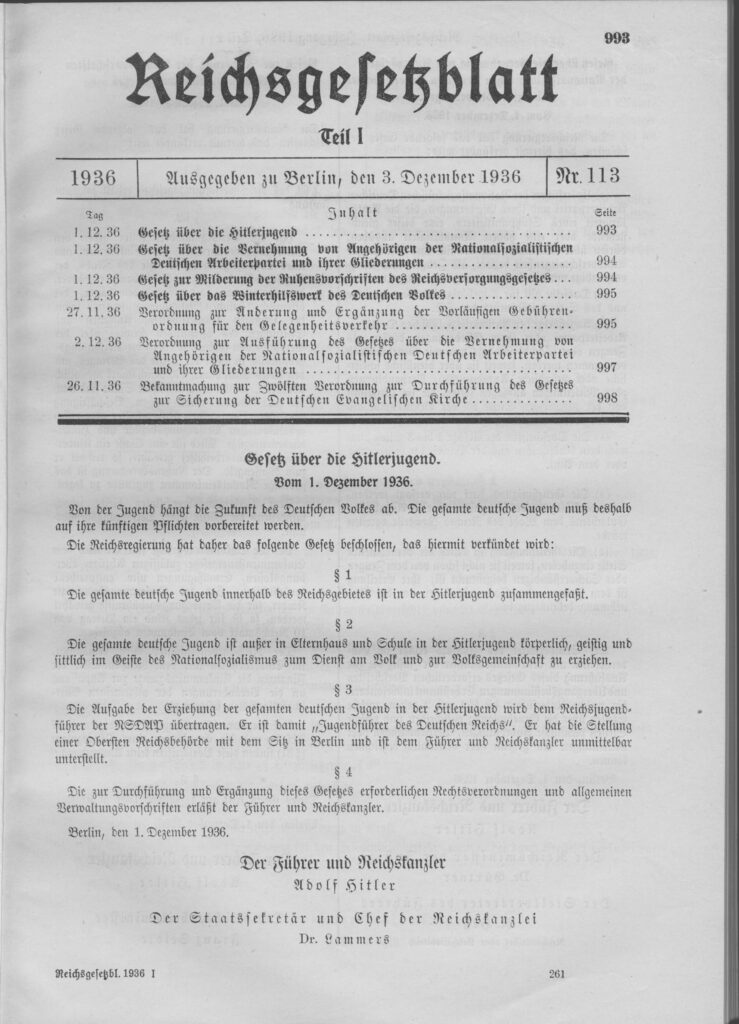
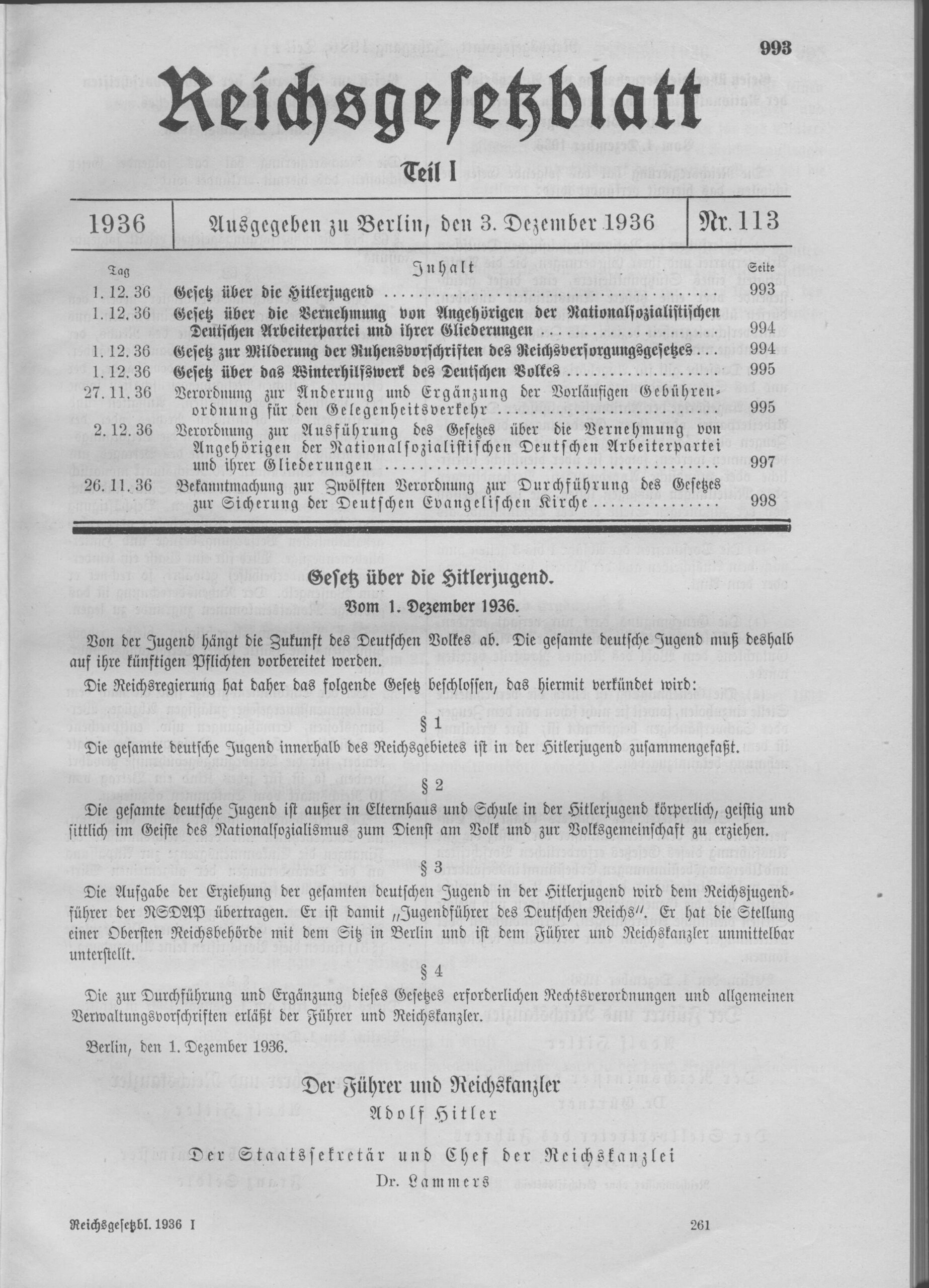
Law concerning the Hitler Youth (English translation from the German original by S. Rauschenbach)
The future of the German people depends on its youth. The whole of German youth must therefore be prepared for its future duties. The Reich government has accordingly resolved upon the following law, which is hereby proclaimed:
- 1 The whole of German youth within the territory of the Reich is organised within the Hitler Youth.
- 2 All German youth, besides being raised in the parental home and at school, shall be educated within the Hitler Youth – physically, intellectually and morally – in the spirit of Nazism, in service to the people and the national community.
- 3 The task of educating the whole of German youth within the Hitler Youth is entrusted to the Reich Youth Leader of the NSDAP. […] He is directly subordinate to the Führer and the Reich Chancellor.
- 4 The Führer and the Reich Chancellor shall issue the provisions necessary to implement this law.
Exercise 2 – A life course under total control
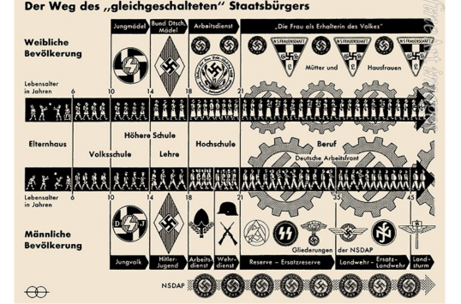
Study the diagram below, showing the ‘path of the coordinated citizen’ through Nazi Germany’s youth and adult organisations, and then answer these questions:
- The diagram presents human life as a system of interlocking gears rather than a list of organisations. What effect does this create?
- Who might have produced a diagram like this, and for what purpose?
- Is it more likely to be a description of the system by the regime itself, or a critical analysis from outside it?
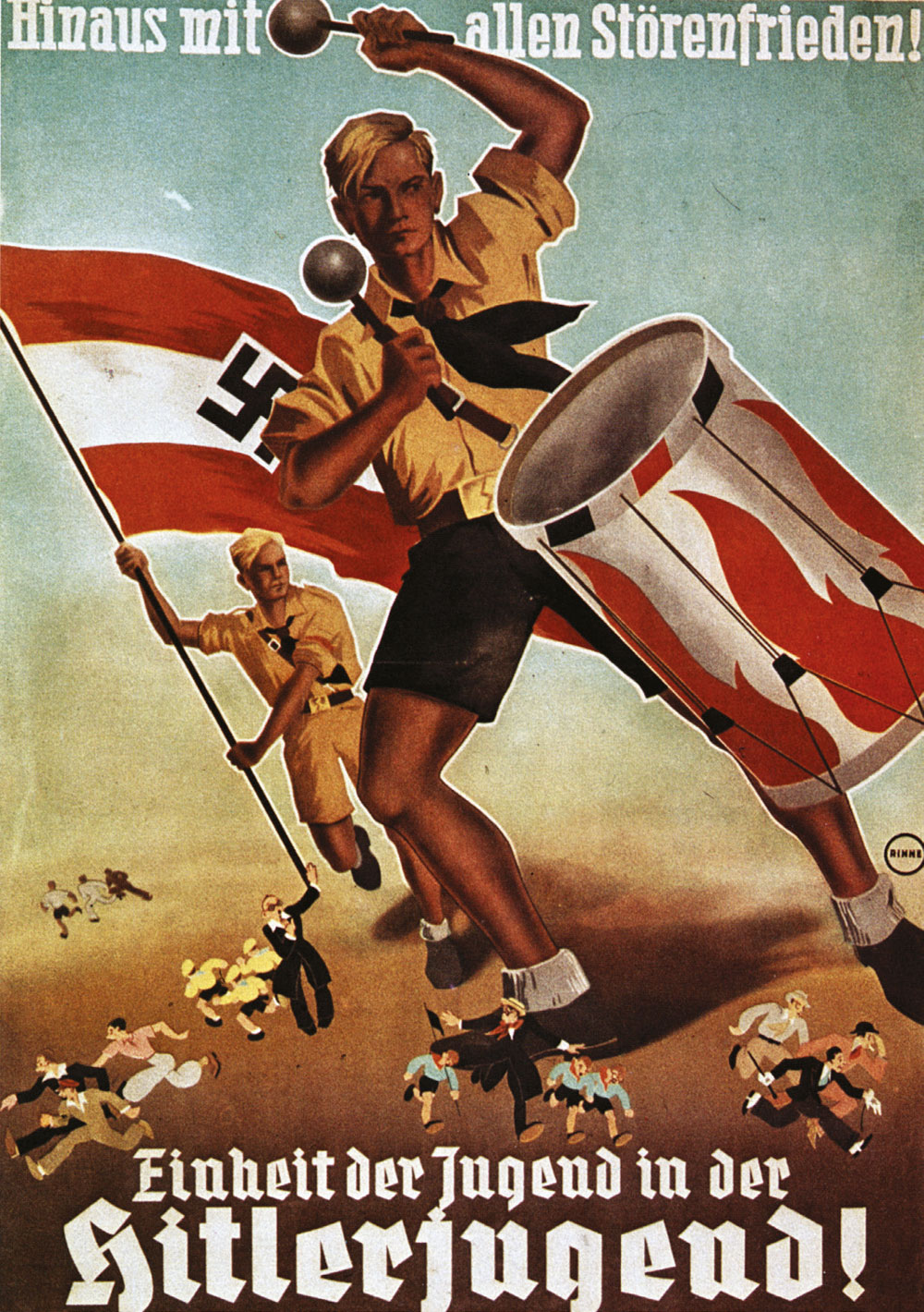
Exercise 3 – Propaganda poster
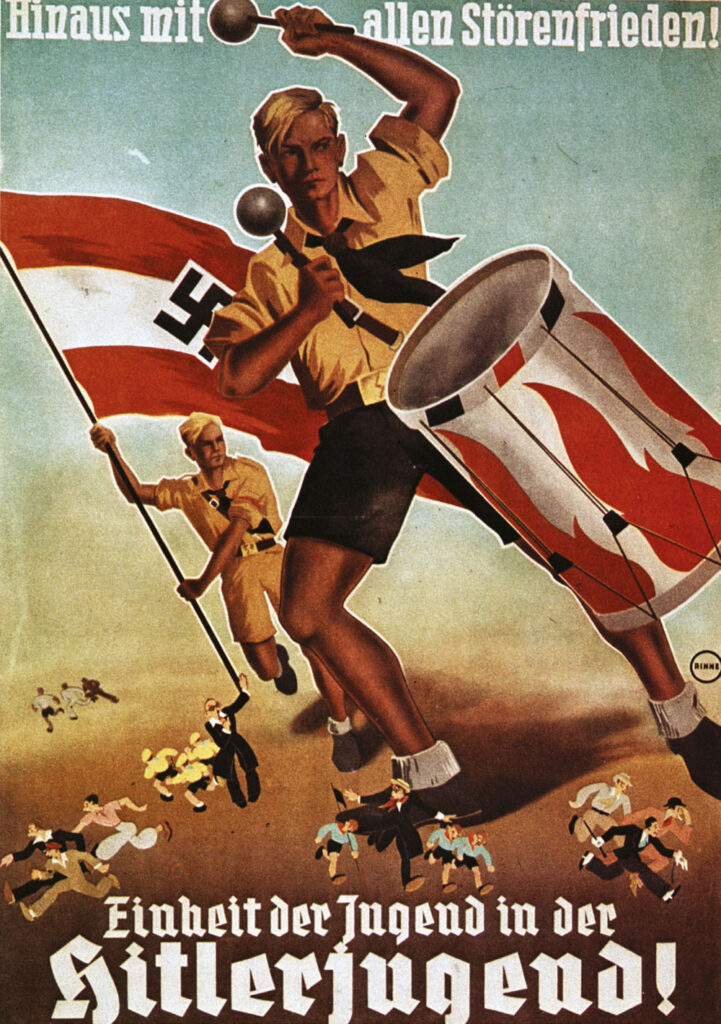
Study the poster below, then answer the question:
How is the Hitler Youth depicted? Considering the other sources you have seen in this unit, does the poster’s message match the reality described elsewhere?
Exercise 4
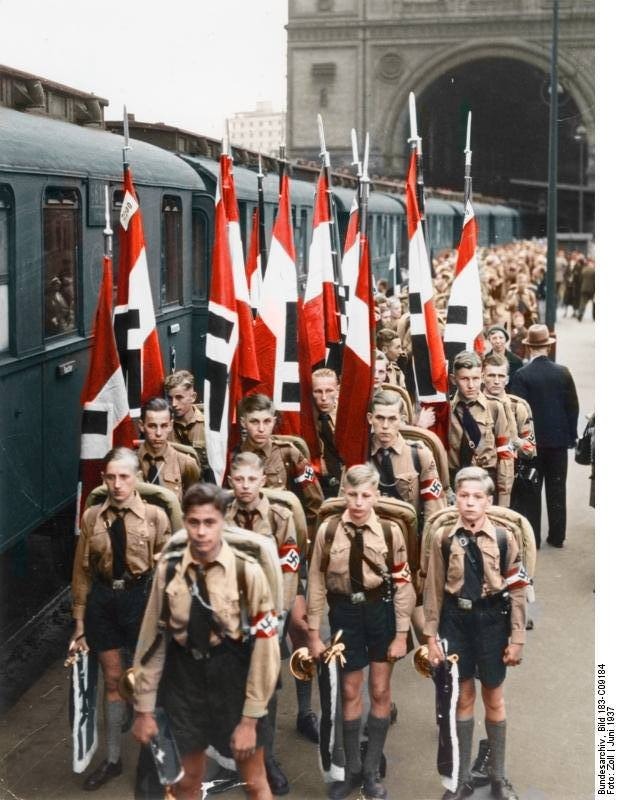
Imagine the activities the boys can expect at their summer camp.
Exercise 5 – The HJ-Streifendienst (Hitler Youth Patrol Service)
The HJ-Streifendienst was the Hitler Youth’s own internal patrol and surveillance service, tasked with supervising members’ behaviour.
Task 1
This is an extract from an official organisational publication issued by the Reich Youth Leadership of the Nazi Party. It presents the duties of the HJ Patrol Service from the institutional perspective of the Hitler Youth. The publication was later reproduced as documentary evidence in the official records of the International Military Tribunal at Nuremberg.
Read its list of duties below and then answer the question:
Sort the duties below into two lists: ones that read as care for young people, and ones that read as surveillance and control. Which duties could just as easily sit on both lists?
The HJ Patrol Service supervises the conduct of all German youth incorporated into the Hitler Youth under the State Youth Law, with regard to general behaviour, uniform regulations, visits to public establishments, inspection of HJ homes for cleanliness and order, supervision of youth hiking activities and youth hostels, steward and guard duty at large events, camp police duties, transport escort service, searches for missing persons and investigations into breaches of duty and criminal acts. Its remit also includes advising and assisting travelling youth, railway station service, protecting youth from criminal elements [criminal groups and influences] , combating juvenile delinquency and protecting public property from the damage caused by Hitler Youth hiking groups, etc.
Source: Aufbau und Abzeichen der Hitler-Jugend, published by the Reichsjugendführung der NSDAP; printed by Deutsche Zentraldruckerei AG, Berlin SW 11. Reproduced in: Trial of the Major War Criminals before the International Military Tribunal, Nuremberg, 14 October 1945–1 October 1946, vol. XXXI (official English text), documents 2605-PS to 3054-PS.
Task 2
Watch the video. Find one example in it that fits your ‘care’ list and one that fits your ‘control’ list from Task Does the video reveal anything the written list leaves out?
Günter Discher describes the wide range of power the Hitler Youth was assigned in the last years of the Third Reich. Günter Discher identified himself with the Swing Youth (Swingjugend) which was a youth counterculture movement in Germany during the 1930s and 1940s. Its members were mainly young people who enjoyed British and American jazz and swing music.
Transcription of the video:
Yes, this so-called Streifen-HJ was founded because there were no longer enough police officers. Most police officers had already been drafted into the Wehrmacht and sent to the front. And in order to continue supervising young people, the Nazis introduced this so-called Streifen-HJ at the time.
The Streifen-HJ essentially consisted of young people, but they were capable of causing harm. In other words, they were dangerous in their own way, because at that time the Hitler Youth could also have people sent to a concentration camp.
To understand this, you have to look at the list: who was actually authorised to send people to a concentration camp? This included first and foremost the youth welfare authorities. Young people had also been sent to camps when they were under youth educational supervision. The Gestapo, the SS and the Security Service could also do this. The Security Service was essentially the Nazis’s organisation for monitoring the mood among the population.
And the Hitler Youth was also authorised to have young people who did not participate, or who were deemed to have committed some offense within the Hitler Youth, sent to a concentration camp via the Gestapo headquarters.
English translation by S. Rauschenbach
Exercise 6 – A victim of indoctrination: Peter Becker
In 1935 Peter Becker was only six years old when his mother enrolled him in a special Hitler boarding school for future Nazi Party officials. He studied the usual academic subjects but was constantly exposed to Nazi ideas and prepared for a military life. Peter was also a member of the Hitler Youth and came to believe in Hitler as the saviour of Germany. He later described his indoctrination as a subtle process: it took him two years after the war ended to come to terms with the atrocities Germany had actually committed – a process he described as very painful. He eventually emigrated to the United States, where he became a historian and professor of modern German history at the University of South Carolina.
Read his testimony below, and then answer these questions:
- What does Peter Becker mean when he describes his indoctrination as ‘a very subtle process’? Find at least two examples in his account of information being withheld from him or reframed.
- Why might an indoctrination that nobody consciously notices be more effective than open pressure or coercion?
Transcript
Now it was in activities, I think, that my life differed from that of a normal boy who went to a state school and went home after school was over and had a normal life at home. Our life was much more structured, and it was much more directed – so that whatever Hitler wanted to do with us, we imbibed it in a very conscientious, careful way. That is, we were not aware of being indoctrinated. We were not aware of what was being done to us. It was all a very, very subtle process.
By the time the war ended in 1945, when I was 15, I had become a Nazi without ever really being aware that I was one – that is, I didn’t know how I’d become one. I knew that I was one, because to me Hitler was the great man in Germany’s life. I had become convinced that Hitler was the saviour of Germany. All of that I could believe because our knowledge of what had gone on in the past was very limited. We were carefully kept from knowing certain things, I think, or from having a broad picture of history.
We were not aware of what Germany had done before. Our history – our life, really – essentially started, as far as we were concerned, with the First World War, with the depressing period of the Weimar Republic, as we were told. Then, after Germany had been beaten down as a result of the Treaty of Versailles, had been disarmed, had been saddled with reparations, etc, etc – all of a sudden, well, then finally Hitler came along to lift Germany out of this muck and mire and bring it back to greatness. And we felt that we were part of that, and we were very proud of that, and thought that Hitler really was the greatest thing that had ever been.
Source (including the interview as video)
[1] Diese Jugend lernt ja nichts anderes als deutsch denken, deutsch handeln […] Und sie werden nicht mehr frei ihr ganzes Leben und sie sind glücklich dabei.
- 1Diese Jugend lernt ja nichts anderes als deutsch denken, deutsch handeln […] Und sie werden nicht mehr frei ihr ganzes Leben und sie sind glücklich dabei. ↩︎