

In this unit, students analyse primary sources, propaganda images, song lyrics and membership data to explore how the Hitler Youth attracted and controlled young people in Nazi Germany.
Key questions
- Was there still a realistic alternative to joining the Hitler Youth once it had absorbed or displaced the other youth organisations?
- What made the Hitler Youth attractive to young people, and how did its appeal compare to what earlier organisations like the Scouts had to offer?
- On the surface, the Hitler Youth resembled the Scout movement – uniforms, camps, hikes and comradeship. Under the surface, in what ways was it a fundamentally different kind of organisation and how did it act as an instrument of a totalitarian state?
The first Nazi youth group was founded in 1922 and banned after the failed Beer Hall Putsch in 1923. It was re-established in 1926 as the Hitlerjugend (HJ), and until 1932 it operated under the control of the SA (Sturmabteilung, the party’s paramilitary wing).
Members joined aged 14 and moved into the SA or the party itself at 18. At first, the organisation focused mainly on political activities and public demonstrations. From the late 1920s, it added camps, hikes and sports, later expanding into activities like motorbiking, sailing and flying.
After the Nazis took power in 1933, almost all other youth organisations were banned or absorbed into the HJ. Catholic youth groups lasted longest, partly protected by a 1933 agreement with the Vatican, but they too were steadily restricted and were finally dissolved in 1938–39.
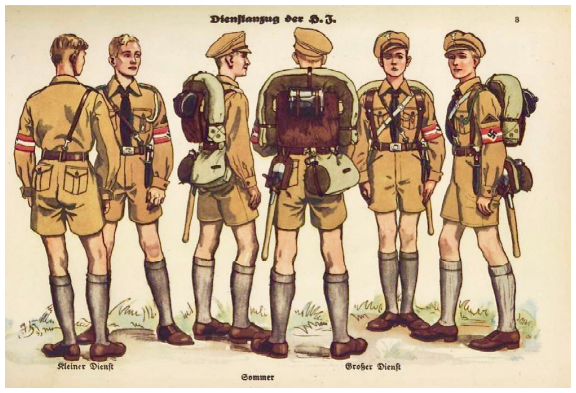
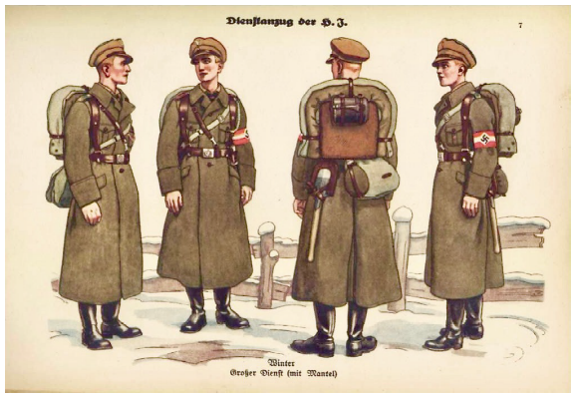
Exercise 1 – The uniform
Describe the uniform below and compare it with uniforms you know from today’s youth organisations, such as the Scouts or para-military groups. What are the differences and similarities to real military equipment?
Exercise 2 – Membership development
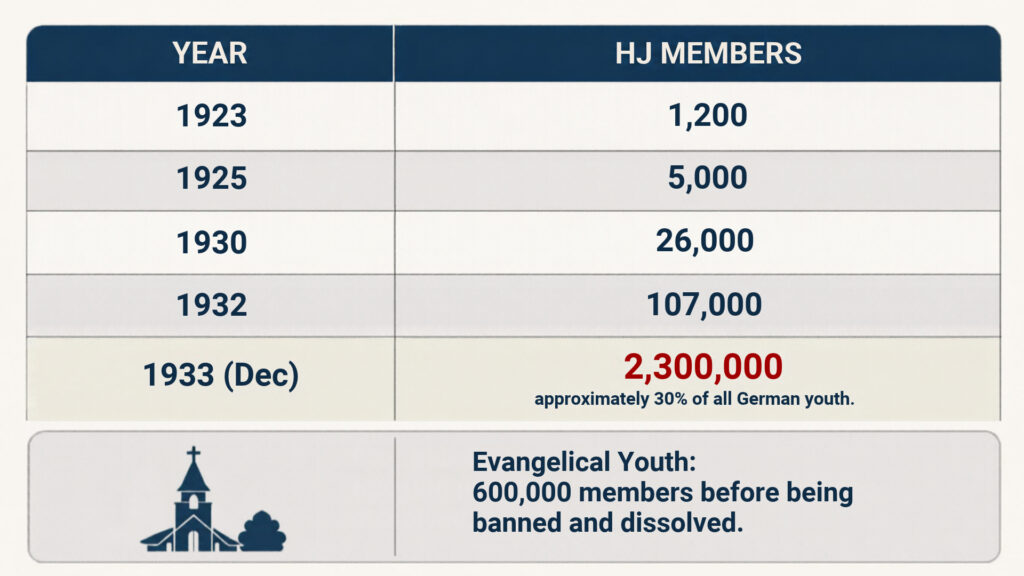
Study the table below, showing the development of HJ membership over time. Then discuss possible reasons for this development. Speculate why roughly 30 per cent of all German youth were HJ members by the end of 1933? Is this rate high or low from your perspective?
Exercise 3 – Joining the HJ: a declaration and an eyewitness account
Arno Löffler, aged ten, declared his membership in the HJ. Read his declaration and answer these questions:
- Imagine you are Arno’s best friend. Ask him why he decided to join the HJ.
- Discuss what membership – or refusing membership – could mean for Arno and for your friendship with him.
- Even though Arno is only ten, there is no field for parental or legal consent on the form. How do you interpret this fact?
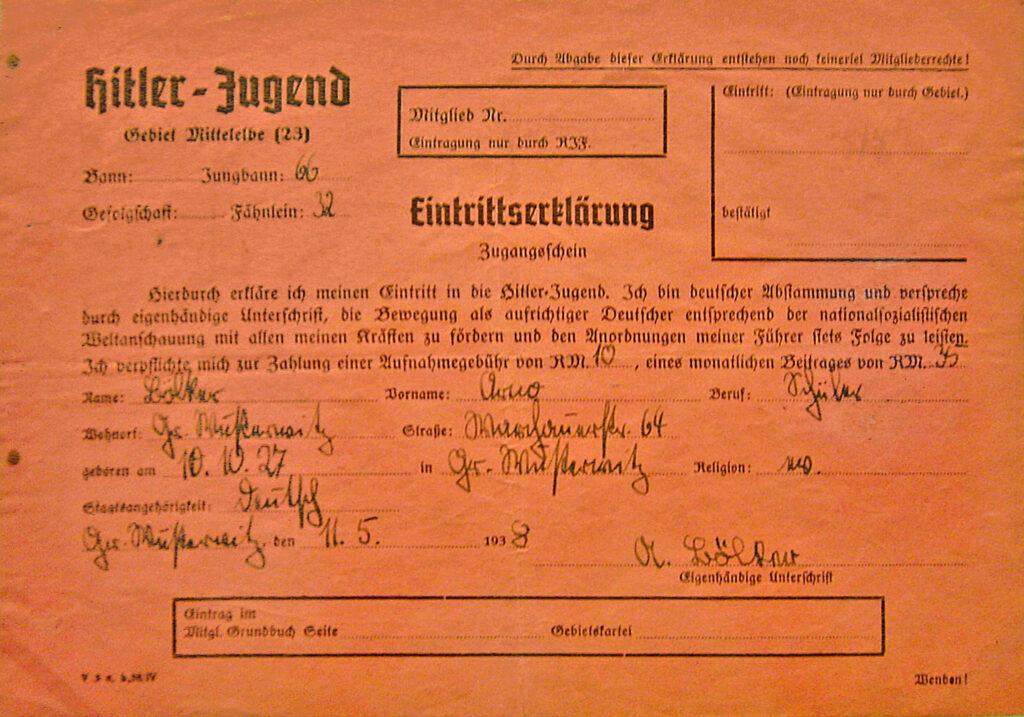
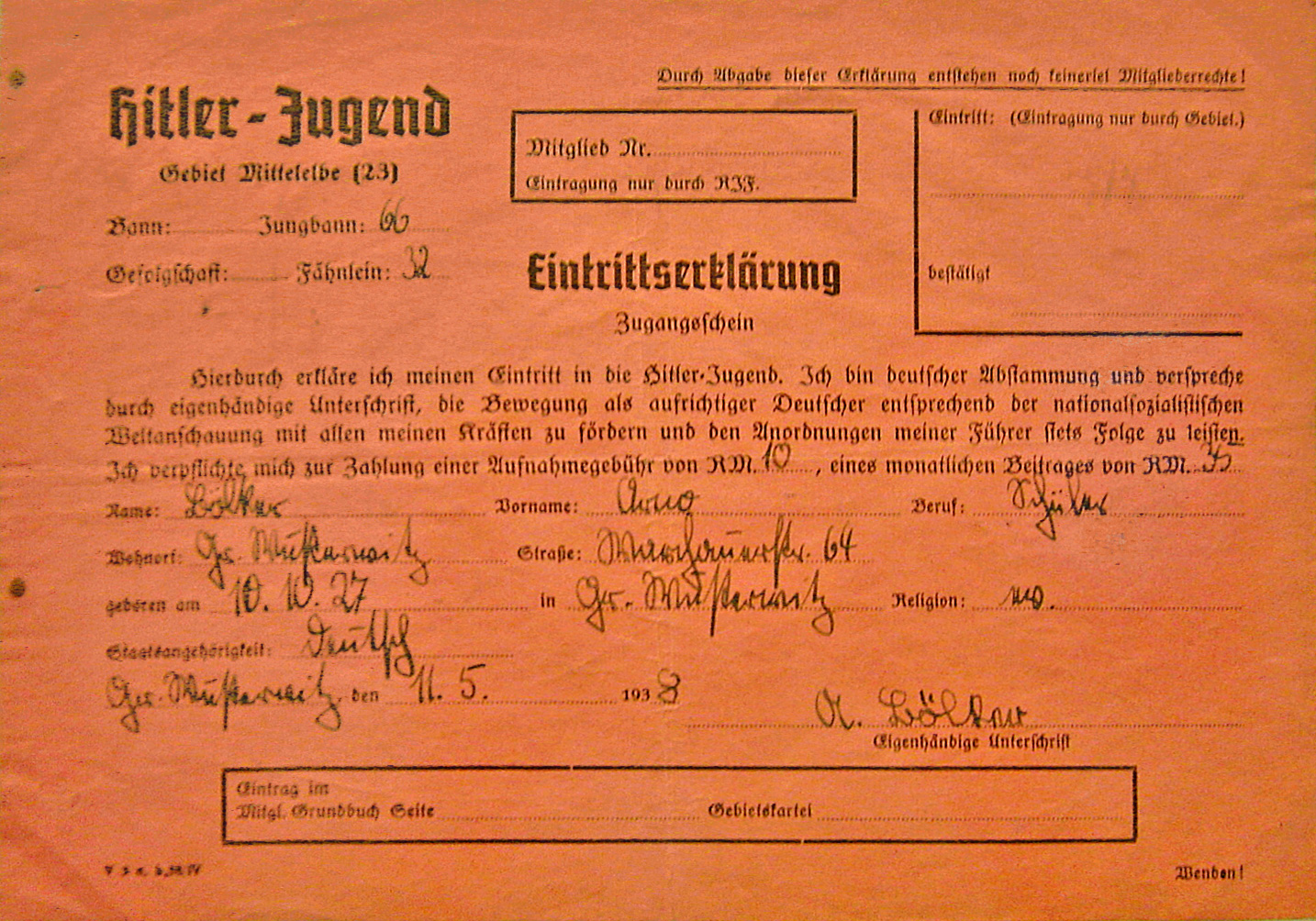
Source: Declaration of enrolment in the Hitler Youth, dated 1938. An exhibit of the German Historical Museum in Berlin. Source: Public domain, Wikipedia.
Hereby I decare my membership in the Hitler Youth. I am of German heritage and promise by giving my signature that, as a proud German, I will support the national socialist ideology with all my might as well as always following my leaders’ orders. I undertake to pay an admission fee of 10 Reichsmarks and a monthly membership fee of 35 Reichspfennigs. (English translation by S. Rauschenbach)
Membership fees were quite high, which often created financial problems for families. Parents also had to buy uniforms and equipment, so some members could not afford proper uniforms. To help poorer members, donations were regularly collected. As a result of these difficulties, membership fees were abolished in October 1940.
Source: https://ausstellungen.museenkoeln.de/nsd_1609_hitlerjugend/02_02_Organisation.html
Exercise 4 – The flag song
‘Unsere Fahne flattert uns voran’ (‘Our flag flies ahead of us’), a Hitler Youth anthem, built its refrain around unconditional loyalty and the glorification of death for the cause. Read the lyrics and translation below, then turn to the task and answer the question:
- Write down three keywords that characterise the song’s message.
- Who is loyalty promised to, and what might be the consequences of that loyalty be?
Uns’re Fahne flattert uns voran — Our flag flies ahead of us
In die Zukunft ziehen wir Mann für Mann — Towards the future we go man by man
Wir marschieren für Hitler — We march for Hitler
Und die Fahne führt uns in die Ewigkeit — And the flag guides us to eternity
Ja, die Fahne ist mehr als der Tod — Yes, the flag is greater than death.
Text: Clara-Louise Noffke; English translation by S. Rauschenbach.
Legal note: singing this song in public may be a criminal offence in some countries.