Key questions
- What attracted young people to join youth organisations?
- What aspects were unattractive or dangerous?
Introduction
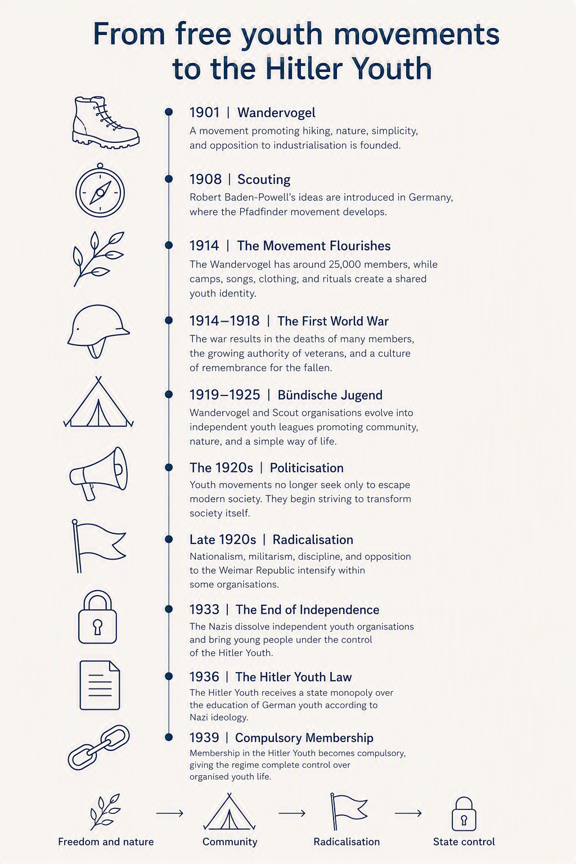
Youth organisations were popular in Europe before the rise of National Socialism (Nazism). The origins of the German Youth Movement started with the founding of the Wandervogel (‘Wandering Bird’) in Steglitz, near Berlin, in 1901. By 1914 the movement comprised 25,000 members, boys and increasingly girls, though the inclusion of girls remained contested and their leadership role developed mainly during the war years. The movement rejected bourgeois industrial civilisation in favour of hikes, camps, folk music and dancing, and cultivated the ideal of ‘the experience of simplicity’ – a deliberate closeness to nature as a reaction to technology and the commercialisation of everyday life.
At the same time, the British army officer Robert Baden-Powell founded the Scout movement, publishing Scouting for Boys in 1908. The doctor and officer Alexander Lion adapted these ideas for German society, giving rise to Pfadfinder (Scouts). German Scout groups developed their own traditions, including uniform-like clothing (Kluft), originally intended to minimise social differences between members. Early Scout groups were generally limited to boys.
Alongside Scouts and Wandervogel, other movements developed, some nonpartisan or culturally oriented, while others were tied to religious communities such as the Katholische Jugend. Songs, symbols, rituals and shared activities became central to group identity, with songbooks that helped bring members together. Religious groups emphasised Christian themes and nationalist groups increasingly used nationalist and military symbols.
The First World War deeply changed these organisations. In 1914 thousands of members of the Wandervogel movement went to fight in the First World War as Feldwandervögel (Feld in German means field). Many former Scouts and youth leaders died in the war, while returning veterans gained authority among younger members, and young people increasingly became leaders themselves. Meetings and ceremonies often were centred on remembering fallen comrades.
Between 1919 and the mid-1920s the older Wandervogel and Scout associations gradually reorganised into what became known as the Bündische Jugend, an umbrella term for independent, largely non-religious youth leagues. These leagues continued to stage camps, hikes and folk events built around romantic images of nature and the homeland, often combined with an ethic of abstinence from alcohol and tobacco and a rejection of middle-class consumerism.
During the 1920s the character of the wider movement shifted from a focus on escaping industrial society towards an ambition to transform society and politics – a tendency present both among left-wing workers’ organisations and among nationalist and conservative youth groups.
Within parts of the Bündische Jugend and some Scout organisations, nationalist ideas gained influence: comradeship, discipline, loyalty and leadership were emphasised. By the late 1920s, many of these organisations had turned openly hostile to the Weimar Republic, with some adopting the black flag in opposition to the republic’s black-red-gold colours.
As the National Socialist German Workers’ Party (NSDAP or Nazi Party) gained political influence at the end of the 1920s, many youth organisations grew interested in the new movement, which embraced themes already present in the nationalist youth scene: discipline, comradeship, sacrifice and national unity. After the Nazi seizure of power, nearly all independent youth organisations were banned and dissolved, their members largely being absorbed into the Hitlerjugend, which by 1933 remained the only permitted youth organisation.
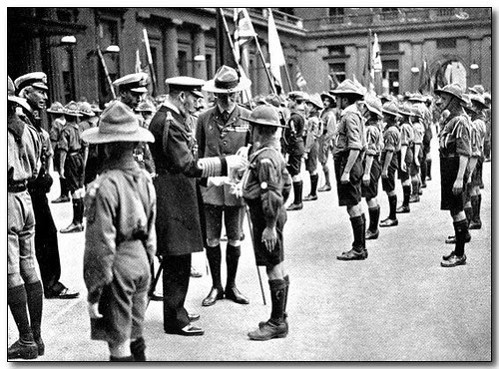
Exercise 1 – The uniform
Describe the pictures below focusing on clothing and equipment, then answer this question: what do these choices indicate about each organisation?
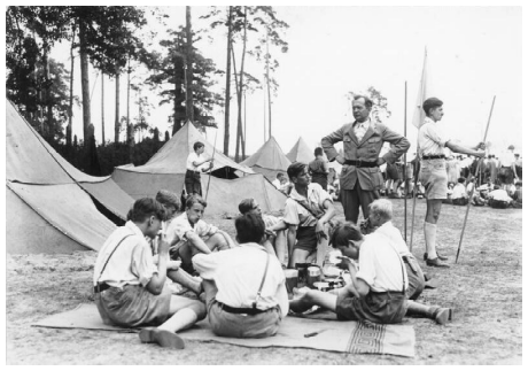
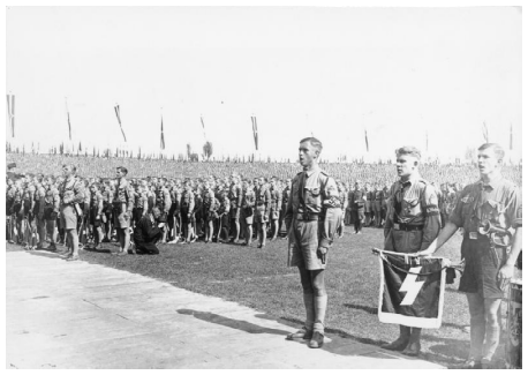
Exercise 2 – The column’s march
Listen to the song below, then read the English translation from German and answer these questions: what imagery and emotions does the song use to describe marching and unity? Who is the song trying to inspire, and how?
Source: ‘Es dröhnt der Marsch der Kolonne’ (YouTube)
It booms the march of the band
The drummer hits the drum
It shines in front of us the sun
She shines so clear and so bright
And no one is there, who gives up hope cowardly
Who tiredly asks for the way
That the drummer drums
It flies the flag ahead of us
In the bright morning wind
We know by its swooshing
That we are brothers in arms
And no one is there, who gives up hope cowardly
Who tiredly asks for the way
That the drummer drums
English translation by S. Rauschenbach, 2026
Legal note: singing this song in public may be a criminal offence in some countries.
Exercise 3 – A different kind of youth song
Unlike the previous song, this one comes from a Catholic youth gathering at Easter 1940. Listen to it below, then read the translation and answer these questions: how does its tone and message differ from the previous song? What might explain the difference?
Source: ‘Lass mich stehen mein Gott’ (YouTube)
English Translation by S. Rauschenbach, 2026
Let me stand my God where I am
Where the storms are blowing
And do not pardon me.
The child will disappear
The man will remain
Do not protect me!
Let me hunt my God
Where the flames hit
And do not cool me
The child will cry
The man will bear them
Do not erase me
Let me find my God
Where the best find each other
And forge me.
From storm and flame.
From child to man
Do not pardon me.
Exercise 4 – Open discussion
Considering what you have learned about youth organisations, discuss the possible benefits and negative impacts of membership in one of these organisations for the members themselves and/or for German society in general.
Exercise 5 – Youth between the Wars
Consider the historical period in which young people of the interwar era came of age. Study the three sources and answer the questions.
Task A
Imagine you were born in 1904, so in 1914 you are turning ten and beginning to take an interest in the world around you. However, by your 19th birthday in 1923, the world looks completely different from the one into which you were born.
Analyse how Germany’s borders changed between 1914 and 1923. How extensive were these territorial changes? How might they have influenced the way people perceived Germany’s role in Europe?
Map of the Europe’s changing borders: https://www.youtube.com/watch?v=Bg7fnSSZcp8&feature=youtu.be
Task B
Besides free-time activities for the betterment of students, young people in the new Weimar Republic had to go to school from Monday to Saturday. The establishment of the new primary schools (Grundschule) was a big shift for many students. The system was established by the Social Democratic government to achieve a closer connection between students from different social strata in their early years.
As a side effect state schools had a growing impact on the students’ political education. The teachers were relicts of the imperial system and the harsh terms of the Treaty of Versailles imposed on German society at the end of the First World War were widely condemned in Germany. Thus it was no surprise that propaganda met the open ears of schoolchildren too.
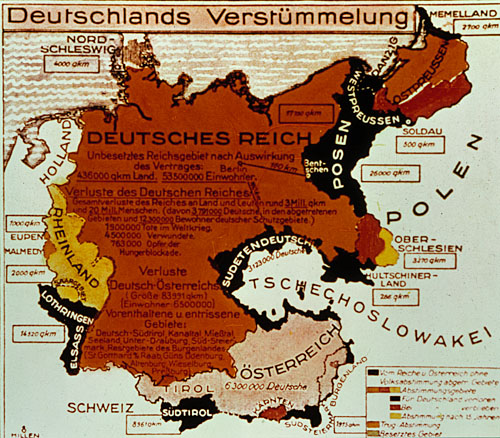
This map was introduced by the German government in 1928 being titled ‘Germany’s Mutilation’ . It was intended to be used in schools and shows the territorial losses after the Great War according to the Treaty of Versailles.
- The black territories signify ‘lost for Germany’, like Elsass-Lothringen (Alsace-Lorraine), Posen (Province of Posen), Westpreußen (West Prussia
- The yellow territories show ‘occupied territories’ like Rhineland, Territory of the Saar Basin, Memel Territory
- Plebiscite areas are marked in different colours like Nordschleswig (Northern Schleswig) or Oberschlesien (Upper Silesia)
This map is a good example of a so-called suggestive maps. The author, Arnold Hillen Ziegfeld, was an early member of the Nazi Party.
Imagine you are a student at a German school. You come into your classroom after the holidays and see this brand new map on the wall.
Discuss with your fellow student(s) what the map illustrates. List the most important aspects.
TASK C
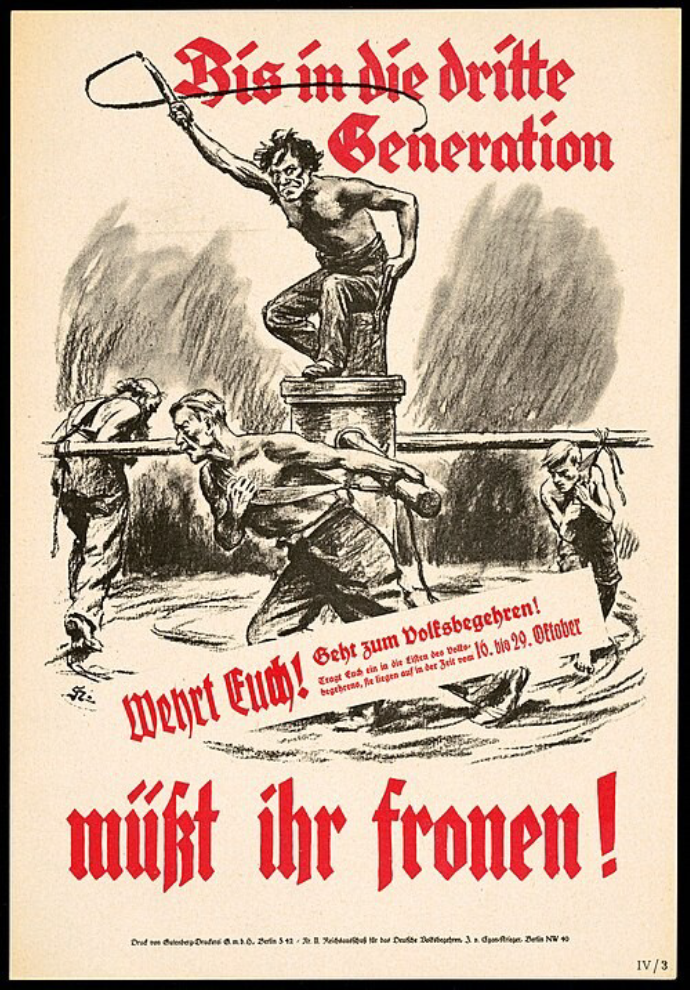
Even propaganda in the streets focused on the young generation. Criticising the Young Plan of 1929,* this poster calls for participation in a plebiscite against this plan.
*After the First World War, Germany was required to pay reparations to the Allied powers, with the total amount set in 1921 at 132 billion gold marks, placing a heavy burden on the German economy.
The Young Plan of 1929 reduced and reorganised the reparations that Germany had to pay after the First World War. The reparations payments were scheduled to continue until 1988. However, the Great Depression made the payments impossible, and Hitler’s government stopped paying them after coming to power in 1933.
Imagine as you walk through the streets of the German city of Hamburg in 1929, you come across this poster. You are not so sure about the composition of the drawing and so you discuss with one of your friends what you can see in this propaganda poster. The key question for you and your friend is whether this slogan is actually aimed at you.
- List the details depicted in the poster and paraphrase the message in your own words.
- Considering that the young boy on the right is from your generation (1929), what can you expect for the future?