

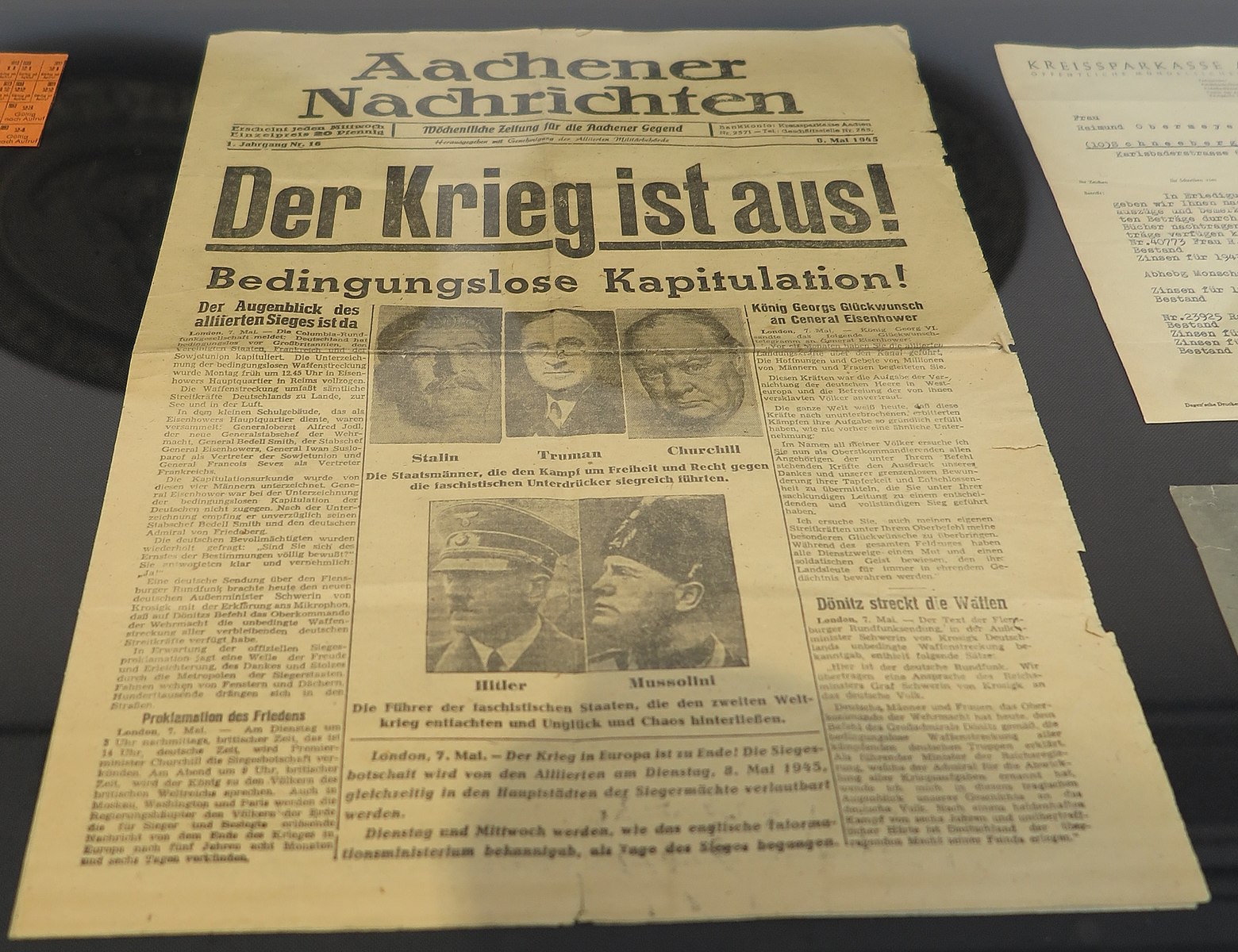
The aim of this exercise is to recapitulate the historical events surrounding the end of World War II and to discuss their significance for the future of Germany. The ambivalence of the commemoration is already apparent here, as two different dates for the end of war were fixed for East and West with May 8 and May 9 and therefore different starting points. At the same time, the dimension of defeat becomes apparent here.
Introduction: How do wars end?
Current examples show how ceasefires and the end of wars are currently being fought over. This raises the question of which factors (can) contribute to the end of a war. Based on this, the events surrounding the end of the World War II in 1945 will be discussed.
Step 1: Historical Facts game: End of World War II – individual/group work or plenary work
The first task is to drag and drop photos to the corresponding historical events on a digital timeline.
This gives the pupils an overview of the factors that ultimately led to Germany’s capitulation. At the same time, it becomes clear at this point that the German Reich had to surrender twice on May 8 and May 9, 1945. The assignment of the images to the historical events can – depending on the digital equipment of the school – be done individually by each pupil or together as a class.
Step 2: Partner work – analysing the historical events surrounding the end of war in 1945
This ‘double surrender’ can be used as a starting point for further research using the material in the Genially Quiz.
The following key questions need to be answered:
• What historical events in April/May 1945 ultimately led to the end of the war/the German defeat?
• How can Germany’s ‘double surrender’ be explained?
Step 3: Discussion of the results in class
The results of the partner work are summarised, different aspects are presented and discussed.
The following questions should be discussed at the end:
• How do you think the end of the war was perceived by the German population?
• Make assumptions about what significance the ‘double surrender’ could have for the future of Germany.